





 Time:2026-08-31
 Source:
As cities grow and consumption increases, the amount of municipal and construction waste generated every day continues to rise. At the same time, many waste streams still contain valuable materials such as metals, plastics, paper, wood, organic matter, and combustible fractions. When these materials are mixed together and sent directly to landfill or incineration, a significant amount of potential resource value is lost.
This is why efficient waste sorting has become an essential part of modern waste management and resource recovery. Instead of treating waste simply as something that needs to be disposed of, advanced sorting technologies make it possible to identify, separate, and recover different materials so they can return to the production cycle.
A well-designed waste sorting system can improve the quality of recovered materials, increase resource recovery rates, reduce the amount of residual waste requiring final disposal, and create better conditions for downstream recycling. With the development of automation and AI waste sorting, modern recycling plants can also process larger volumes of mixed waste with greater consistency and less dependence on repetitive manual sorting.
As a professional waste sorting equipment manufacturer, Qinglv provides turnkey waste sorting and resource recovery solutions, integrating shredding, screening, mechanical separation, AI recognition, robotic sorting, metal recovery, air separation, and RDF processing technologies into customized recycling systems.
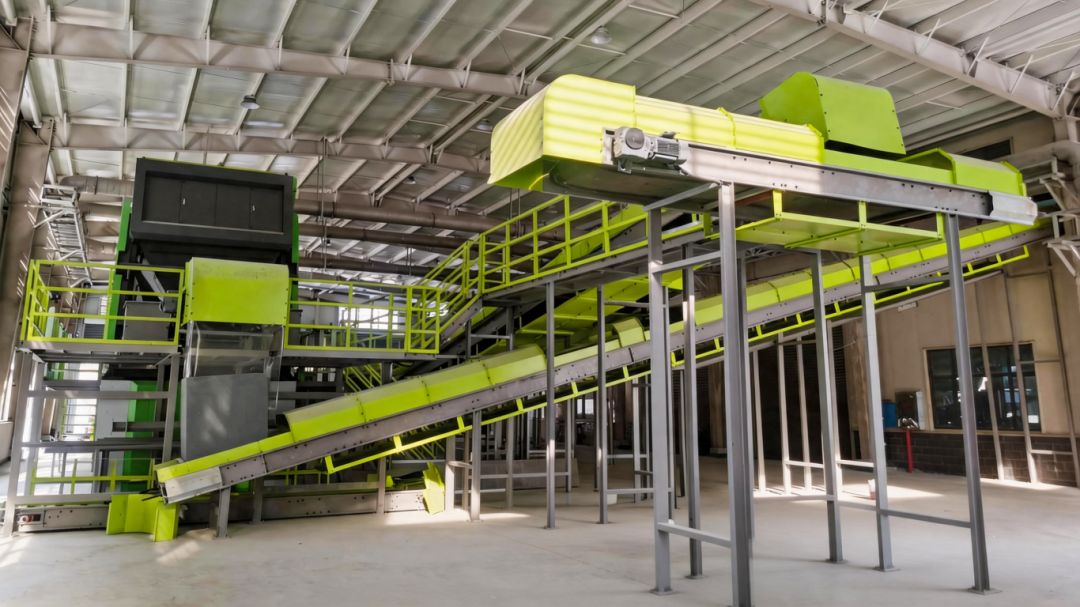
Why Efficient Waste Sorting Is Essential for Resource Recycling
The value of recycling depends not only on how much waste is collected, but also on how effectively useful materials can be separated from unwanted fractions. Mixed waste often contains different materials with completely different physical and chemical characteristics. If these materials are not separated at the right stage, contamination can reduce their recycling value and make downstream processing more difficult.
An advanced waste sorting system addresses this problem by using multiple separation technologies at different stages of the process. Screening equipment can classify materials according to particle size and shape, while magnetic and eddy current separation can recover ferrous and non-ferrous metals. Wind separation can distinguish lightweight materials from heavier fractions, and optical sorting or AI-based systems can identify specific recyclable materials.
This multi-stage approach allows a recycling plant to create cleaner and more consistent material streams. Instead of treating mixed waste as one material, the system separates it into different resource categories that can be directed toward appropriate recycling or recovery processes.
For this reason, waste sorting is not simply a preliminary step in waste treatment. It is a key link connecting waste management with the circular economy.
Recovering More Materials From Existing Waste Streams
One of the most important benefits of advanced waste sorting is that it increases the amount of usable material that can be recovered from waste. Metals, plastics, paper, textiles, wood, organic fractions, and combustible materials can all have different recovery pathways.
For example, ferrous metals can be separated using a Magnetic Separator, while aluminum and other non-ferrous metals can be recovered through an Eddy Current Separator. Lightweight plastic films and paper can be separated using a Wind Shifter, while different particle sizes can be classified using a Disc Screen, Star Screen, or 3D Sorter.
When these machines operate as part of an integrated waste sorting system, the recovery process becomes more systematic. Materials that would otherwise be lost in mixed residual waste can be directed into recycling, reuse, or energy recovery streams.
Improving the Quality of Recovered Materials
Resource recovery is not only about quantity. The quality of recovered materials is equally important.
For example, recyclable plastics contaminated with organic waste or mixed with unsuitable materials may have limited commercial value. Similarly, metal recovery becomes more valuable when recovered metals contain fewer non-target materials.
Advanced screening and separation technologies can help reduce contamination before materials reach downstream recycling processes. AI Optical Sorters and AI Sorting Robots can provide an additional level of precision by identifying specific materials based on visual characteristics and other sensor information.
By combining mechanical separation with intelligent sorting, a modern recycling plant can produce more defined material streams and improve the potential value of recovered resources.
How Qinglv Waste Sorting Equipment Improves Resource Recovery Efficiency
Qinglv Environment provides integrated waste sorting solutions tailored to different waste streams, including municipal solid waste, construction and demolition waste, and industrial solid waste. By combining pre-treatment equipment such as Bag Breakers and Shredders with advanced screening and separation technologies—including Disc Screens, Star Screens, Flip Flop Screens, 3D Sorters, Magnetic Separators, Eddy Current Separators, and Wind Shifters—Qinglv’s systems are designed to adapt to varying material compositions and processing requirements. This modular approach helps improve material flow, reduce contamination, and increase the purity of recovered fractions.
The overall system is built around automated, energy-efficient machinery that supports continuous operation and reduces manual intervention. Key technologies such as AI sorting and dynamic screening surfaces help maintain stable performance even when processing difficult materials like wet, sticky, or fine waste. By separating recyclables into clean streams—including ferrous and non-ferrous metals, lightweight combustibles, and construction aggregates—the system contributes to higher resource recovery rates and improved economic returns for recycling facilities.
AI Waste Sorting and Robotic Sorting Improve the Precision of Resource Recovery
Mechanical equipment provides the foundation of an efficient recycling plant, but some materials require more precise identification. This is where AI waste sorting and robotic automation can further improve resource recovery.
AI Optical Sorter: Intelligent Identification of Recyclable Materials
Qinglv’s AI Optical Sorter combines AI vision recognition with optional hyperspectral, laser, and metal detection technologies. This multi-modal sensing approach allows the system to identify more than 30 types of recyclable materials under complex operating conditions.
The equipment supports conveyor belt speeds of up to 5 m/s and can reach a maximum processing capacity of 10 tons per hour. Its advanced lighting technology is designed to maintain stable recognition performance under changes in external light, temperature, and humidity. Cloud-based intelligent upgrades, remote fault response, and predictive maintenance capabilities further improve system management. By adding AI recognition to conventional mechanical separation, the AI Optical Sorter enables more precise material recovery and supports the development of intelligent MSW sorting technology.
AI Sorting Robot: Automating Fine Sorting and Quality Control
Qinglv’s AI Sorting Robot is designed for fine sorting at the front end of the process and quality control at the end of the recycling line. It combines AI visual recognition with an advanced robotic execution system, allowing recyclable materials to be identified and picked automatically from moving conveyor belts.
The three-axis robotic system can perform up to 5,400 picks per hour and simultaneously sort up to eight categories of materials. It can recognize more than 30 recyclable materials, with a real-world recognition rate of at least 95% for mixed municipal waste and up to 99% for intact plastic bottles under the specified application conditions. The robot can use different end-effectors, including suction and gripping tools, according to the incoming material. Cloud-based upgrades and predictive maintenance functions further support continuous operation. Compared with repetitive manual sorting, waste sorting robots can provide more consistent automated picking and help create safer working environments.
This combination of AI recognition and robotic waste sorting is particularly valuable when recycling plants need to recover specific materials from high-volume waste streams.
From MSW Sorting to a Complete Resource Recovery System
Efficient resource recycling does not end when materials are separated. The recovered fractions must also be directed toward appropriate downstream applications. This is why a complete waste management strategy should consider the entire process from incoming waste to final recovered products.
After screening and sorting, recyclable metals can enter metal recycling streams, plastics and other materials can be directed toward appropriate recycling processes, and suitable combustible fractions can be processed into alternative fuel.
Qinglv’s RDF Pellet Machine can process suitable mixtures of plastics, textiles, rubber, leather, and other combustible materials through high-density compression and screw extrusion. The system can directly process relatively wet materials and reduce moisture during extrusion, with the resulting RDF pellets reaching a moisture content below 20% under the specified operating conditions. Pellet size and shape can be adjusted according to requirements, while the automatic control system and anti-blockage design help maintain stable operation and reduce maintenance needs.
In this way, the waste sorting process becomes part of a broader resource recovery chain rather than simply ending with the separation of materials.
Why Choose Qinglv for a Turnkey Waste Sorting System?
An efficient recycling plant requires more than a collection of individual machines. The equipment must work together according to the characteristics of the incoming waste, the desired recovered materials, available space, processing capacity, and downstream utilization requirements.
Qinglv provides turnkey waste sorting solutions, covering process design, equipment selection, manufacturing, installation, commissioning, and technical support. Depending on project requirements, Qinglv can integrate a Shredder, Bag Breaker, Disc Screen, 3D Sorter, Star Screen, Flip Flop Screen, Magnetic Separator, Eddy Current Separator, Wind Shifter, AI Optical Sorter, AI Sorting Robot, and RDF Pellet Machine into a complete automated system.
This integrated approach allows each stage to support the next. Pre-treatment prepares the material, screening separates different size fractions, mechanical equipment classifies materials according to physical characteristics, magnetic and eddy current systems recover metals, air separation handles lightweight fractions, and AI technologies provide more precise identification and sorting.
The result is a complete waste sorting system designed not simply to process waste, but to maximize the amount of material that can be recovered and returned to the circular economy.
The Long-Term Benefits of Better Waste Sorting for the Circular Economy
Improving waste sorting can have benefits throughout the resource cycle. When more recyclable materials are successfully separated, fewer resources are lost through landfill or other final disposal methods. Cleaner recovered materials can also provide better feedstock for recycling companies and manufacturers.
From a resource perspective, recovering metals, plastics, paper, and other materials reduces the need to rely entirely on virgin raw materials. From an economic perspective, separating valuable materials creates additional opportunities for recycling and resource utilization. From an environmental perspective, reducing the volume of residual waste can lower the demand for final disposal and support more sustainable waste management.
Advanced waste sorting therefore plays a role far beyond the recycling plant itself. It connects collection, sorting, recycling, manufacturing, and resource reuse into a more complete circular system.
As AI, automation, screening, and separation technologies continue to develop, the role of MSW sorting machines, waste screening machines, waste sorting robots, and other intelligent equipment will become increasingly important in modern resource recovery infrastructure.
Conclusion: Better Waste Sorting Creates Greater Resource Recovery Potential
Waste is not simply the end of a product's life cycle. A large proportion of mixed waste still contains materials that can be recovered, recycled, reused, or converted into alternative resources.
The challenge is to separate these materials efficiently and consistently.
Advanced waste sorting systems provide the technology needed to turn mixed waste into organized material streams. Mechanical screening equipment can classify materials by size and physical characteristics, magnetic and eddy current separation can recover metals, Wind Shifters can separate lightweight materials, and AI Optical Sorters and waste sorting robots can provide more precise identification and automated sorting.
With its integrated range of Shredder, Bag Breaker, 3D Sorter, Disc Screen, Star Screen, Flip Flop Screen, Magnetic Separator, Eddy Current Separator, Wind Shifter, AI Optical Sorter, AI Sorting Robot, and RDF Pellet Machine, Qinglv provides complete turnkey solutions for modern waste management and resource recovery projects.
The goal of advanced waste sorting is not simply to process more waste. It is to recover more value from every ton of waste.
By improving sorting efficiency, material purity, automation, and downstream resource utilization, intelligent waste sorting can help build a more efficient recycling system and support the transition from traditional waste disposal toward a more circular and resource-efficient future. Contact us to get the custom waste sorting solution!
 Prev
Prev