





 Time:2026-01-07
 Source:
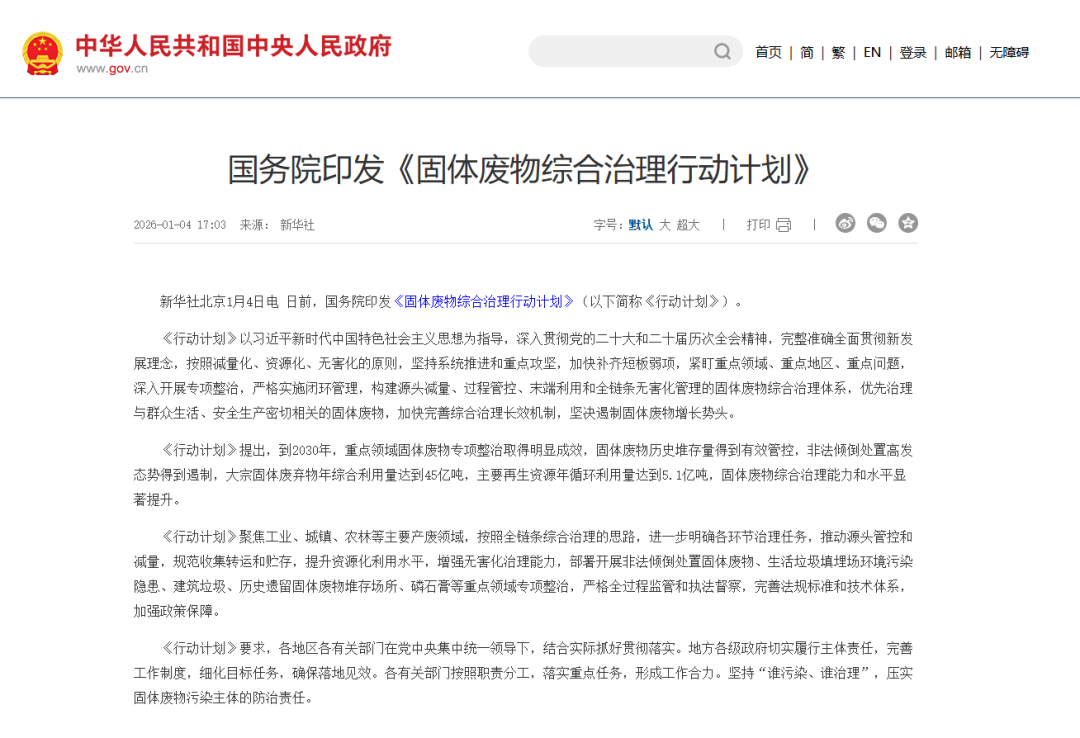
At the beginning of 2026, China's ecological civilization construction has welcomed another heavyweight top-level design. On January 4th, the State Council officially issued the Comprehensive Solid Waste Management Action Plan (hereinafter referred to as the Action Plan). The release of this guiding document not only reflects the country's firm determination to deepen green, low-carbon, and circular development but also sounds a clarion call for the waste resource recovery industry, which is at a critical stage of transformation and upgrading.
01 Goal Setting: A Trillion-Level Resource Recovery Blueprint Accelerates
The Action Plan, positioned at the strategic intersection of the 14th and 15th Five-Year Plans, clearly outlines the core governance goals of "reduction, resource recovery, and harmless treatment." The document states that by 2030, China will establish a full-chain solid waste management system. The annual comprehensive utilization volume of bulk solid waste will exceed 4.5 billion tons, and the recycling volume of major renewable resources will reach 510 million tons. Behind this series of hard targets lies a profound transformation in the governance model—from traditional end-of-life landfilling to precise whole-life-cycle management, and from simple harmless treatment to high-value resource recovery development.
02 Shifting Focus Upstream: Sorting Elevated as the Logical Starting Point for Resource Utilization
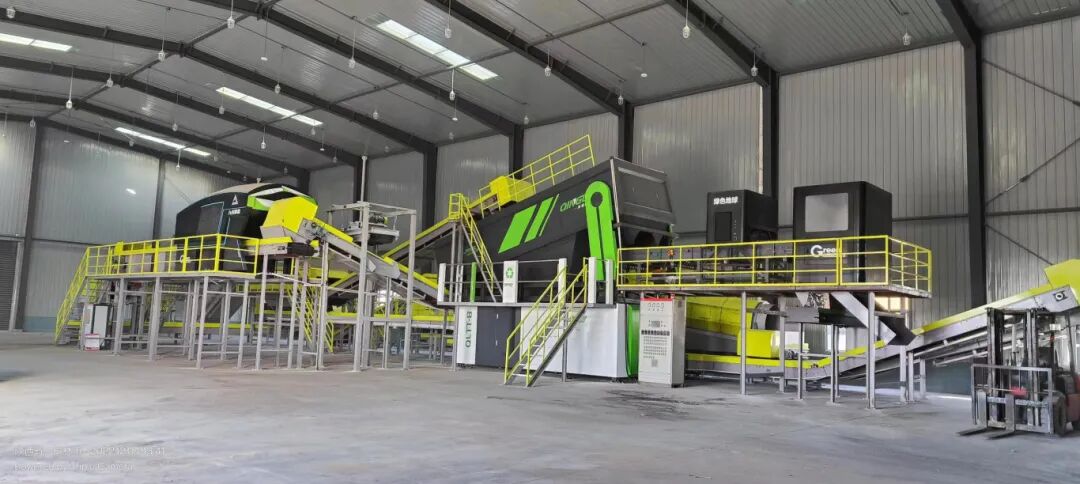
In this transformation, the importance of the sorting segment has been systematically moved upstream. The Action Plan explicitly calls for improving the collection, transportation, storage, and utilization systems for solid waste, promoting whole-process management and front-end treatment. This means that efficient, stable, and standardized sorting and processing capabilities will become a prerequisite for subsequent resource recovery and compliant disposal, whether for municipal solid waste, construction and demolition waste, industrial solid waste, or historical legacy solid waste.
03 Hub Empowerment: Sorting Systems Shift from "Optional Configuration" to "Core Necessity"
Sorting is the "hub" connecting front-end classification with back-end utilization and disposal. Relying solely on classified disposal cannot meet subsequent processing requirements. Systematic sorting is essential to effectively divert different material streams into incineration, recycling, or safe disposal channels. The Action Plan's systematic deployment of collection, transportation, storage, and utilization systems is, in essence, a systematic requirement for sorting capacity.
This sends an extremely clear signal: waste sorting is no longer an "optional configuration" but is becoming a "basic configuration" in project planning and implementation. The requirement for sorting system configuration in new solid waste projects will continue to increase. Existing projects will also face the practical need for sorting capacity upgrades and technological retrofits. The necessity and certainty of equipment investment are significantly enhanced, and the "rigid demand" for sorting production lines is poised for explosive growth.
04 Standard Upgrading: Intelligence and Professionalization Drive Industry "Survival of the Fittest"
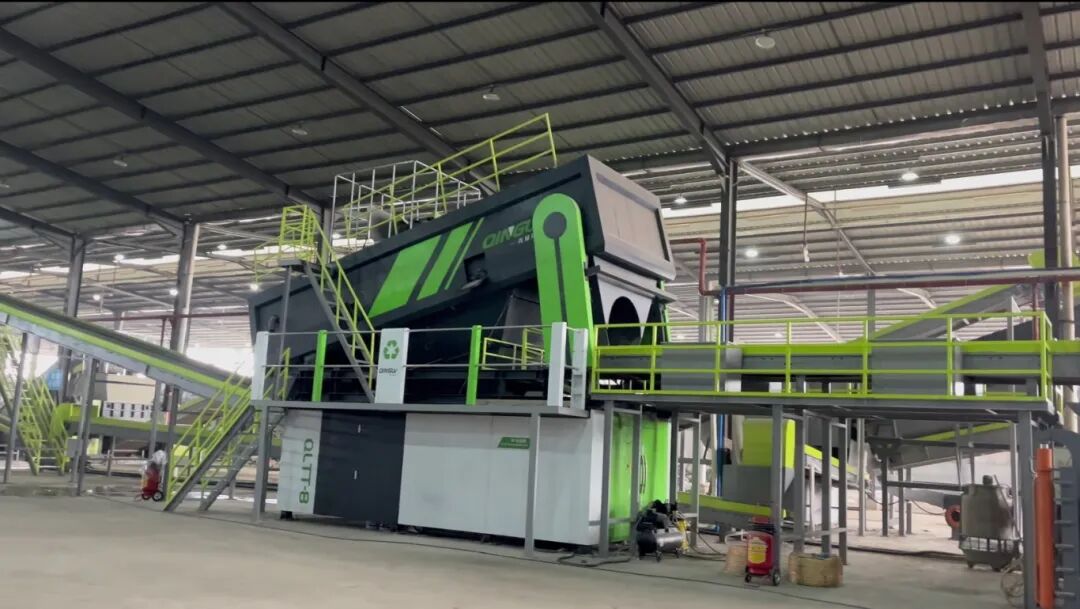
Regarding the industrial environment, the Action Plan also emphasizes whole-process supervision and standard system development. As supervision tightens and technical standards continuously improve, low-level, non-standard sorting models will gradually be phased out, and industry concentration is expected to increase steadily. Companies possessing automated, intelligent sorting technologies, along with engineering implementation and operational management capabilities, will gain a clear competitive advantage. The industry development environment will become more favorable for the long-term planning of specialized, scaled enterprises.
Rebuilding the Solid Waste Management System with Sorting as the Foundation
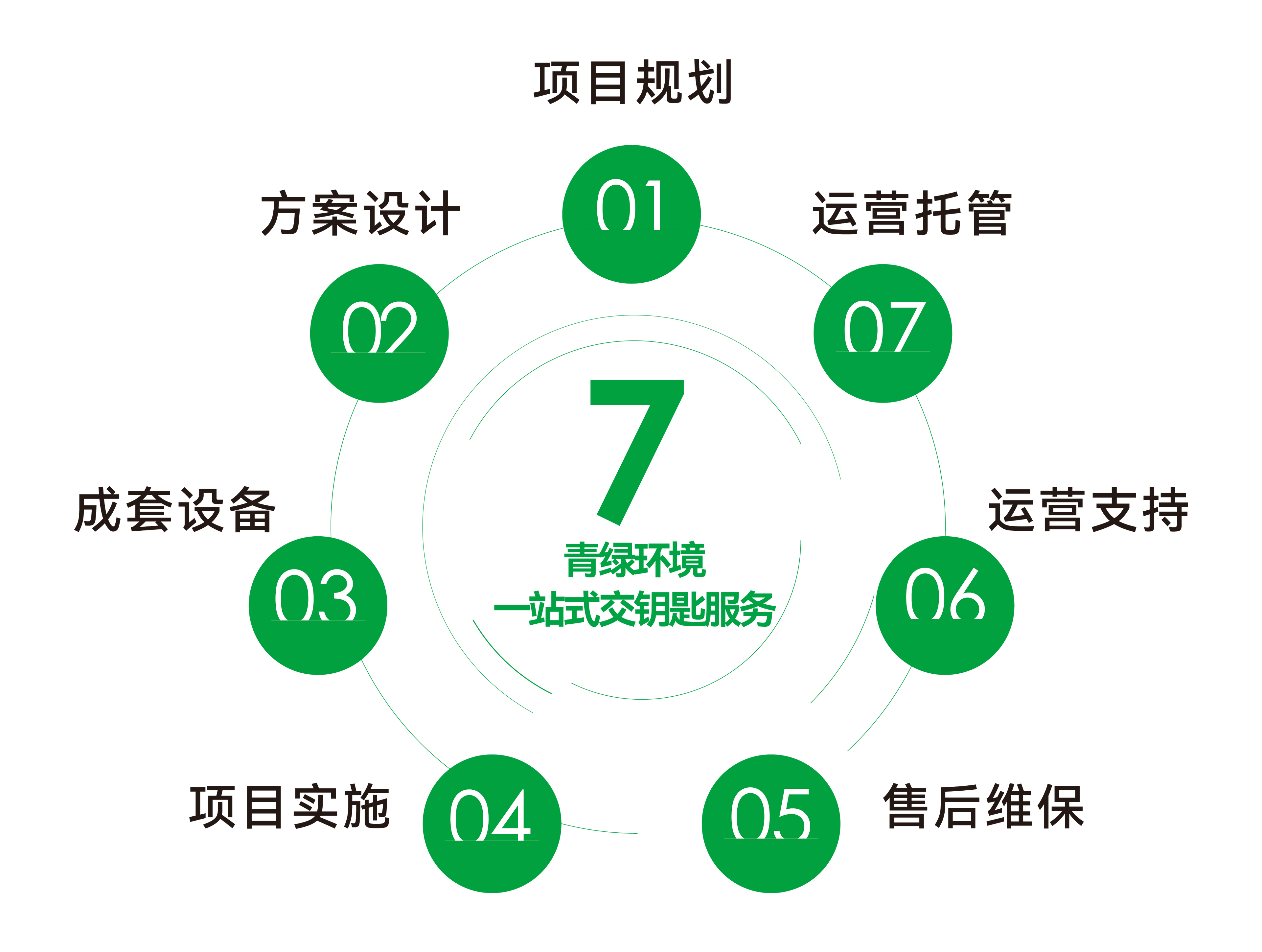
In summary, the release of the Comprehensive Solid Waste Management Action Plan essentially promotes a structural upgrade of the solid waste management system toward being "sorting-based."
Sorting is no longer a secondary link in solid waste management but a key fulcrum determining the level of resource recovery, project compliance, and high-quality industry development.
For investors and operators planning or advancing solid waste projects, proactively deploying high-standard, highly reliable sorting systems is an inevitable choice to align with policy direction and ensure the long-term, stable operation of projects.
 Prev
Prev