





 Time:2026-09-30
 Source:
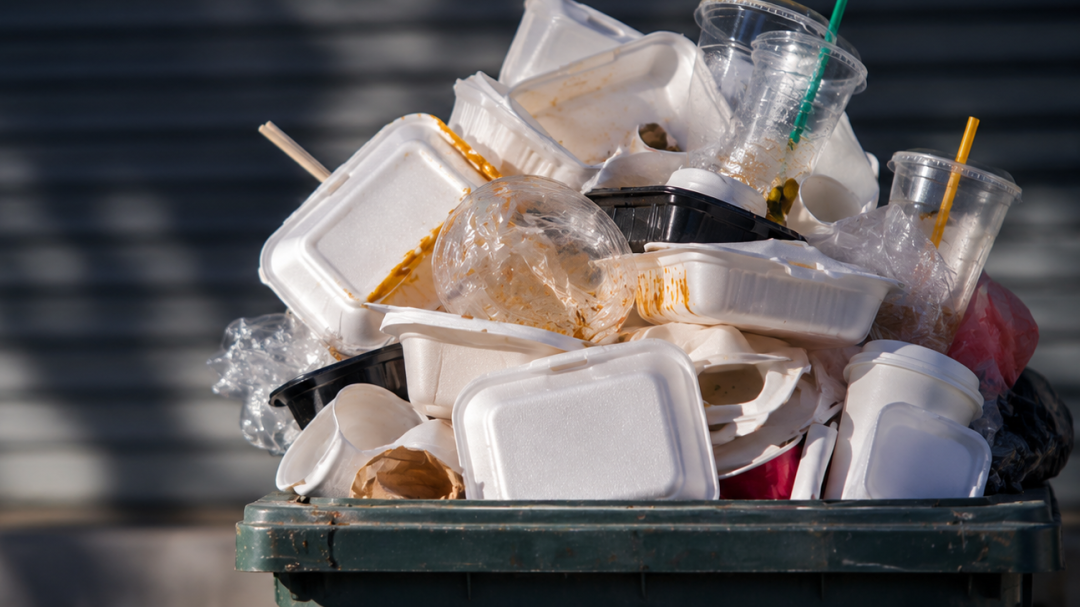
Disposable lunch boxes, milk tea cups, and packaging bags – these items are not impossible to recycle, but the cost of recycling and disposal often exceeds the revenue from selling them, making it difficult to sustain through market mechanisms alone.
Data from the National Development and Reform Commission shows that in 2021, China's urban and county-level domestic waste clearance volume was about 317 million tons, with low-value recyclables accounting for 40–50%, generating about 140 million tons annually, and a material utilization rate of less than 30%.
These materials do have resource value, but due to their low unit value, dispersed sources, high impurity content, and high collection, transportation, and sorting costs – for example, various plastic products such as PP, PVC, HDPE, etc., when sold mixed versus sorted separately, show huge price differences – in the past, actual recycling often faced the problem of "uneconomical recycling and insufficient utilization."
Policy Support Intensifies, Opening a New Window for Low-Value Recycling
Today, this sector is seeing clearer policy direction.
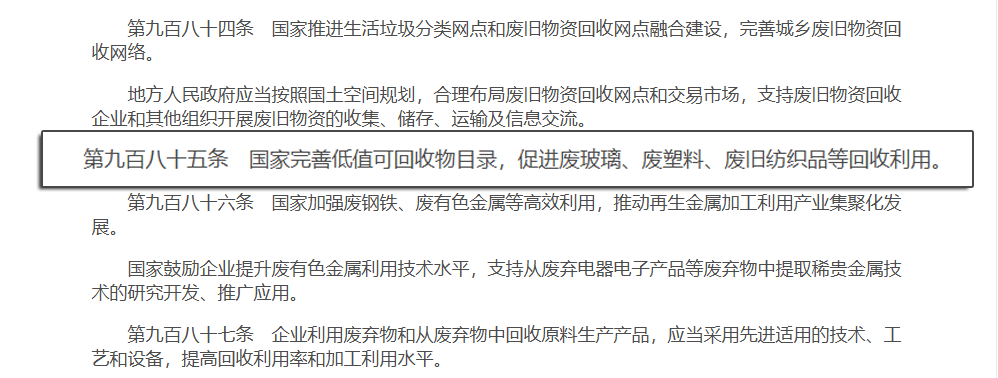
The Ecological Environment Code of the People's Republic of China, which came into effect in March 2026, explicitly states that the state shall improve the catalog of low-value recyclables, promote the recycling and utilization of waste glass, waste plastics, waste textiles, etc., and require coordinated planning of collection, sorting, and baling outlets to advance the resource utilization of domestic waste.
In April 2026, Guangzhou revised and issued the Guangzhou Measures for Purchasing Low-Value Recyclables Recycling and Treatment Services. The document specifies that Guangzhou can support low-value recyclables recycling and treatment through government procurement of services, with municipal and district finances bearing the cost at a 7:3 ratio.
In 2026, Liaoning Province issued the Three-Year Action Plan for Improving the Quality and Efficiency of Domestic Waste Classification, proposing to strengthen the recycling and regeneration of low-value recyclables, and encouraging qualified cities to build low-value recyclables collection and sorting centers, or set up dedicated areas in comprehensive sorting centers for centralized sorting and processing of lightweight packaging, low-value plastics, mixed recyclables, waste glass, waste textiles, etc.
This means that the treatment of low-value recyclables is gradually shifting from "whether recycling is necessary" to "how to build a more stable and efficient recycling and utilization system."
Sorting Efficiency: A Key Step in Unlocking Value from Low-Value Materials
Therefore, sorting actually serves as a critical link connecting "recycling" and "resource utilization."
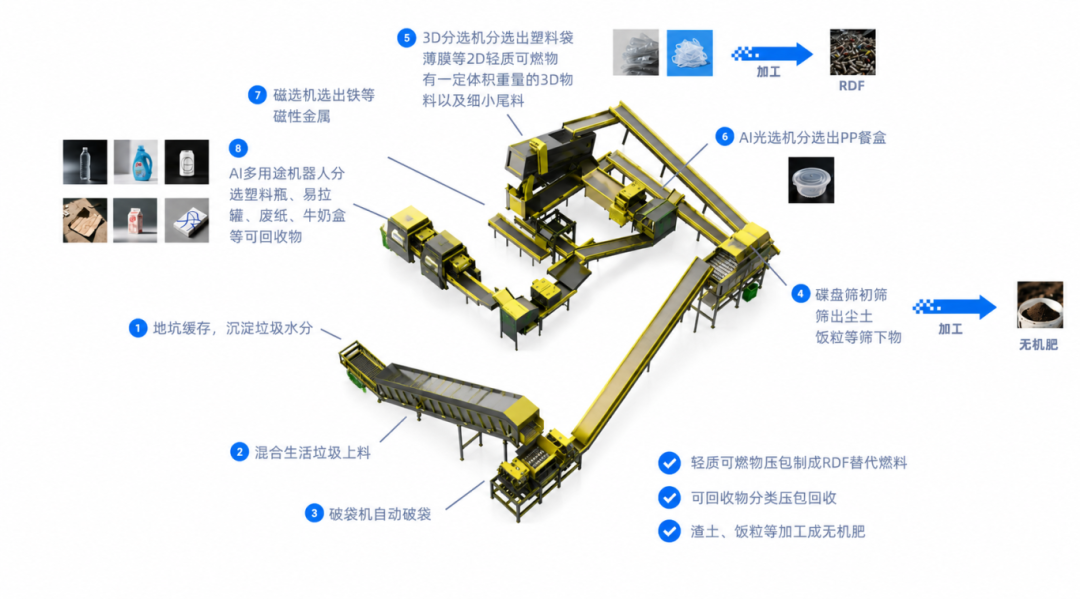
Through processes such as bag breaking, screening, magnetic separation, air classification, and 3D sorting, materials can first be preliminarily separated by particle size, shape, and weight, and then finely sorted by material type to maximize the purity of target materials. For some complex scenarios, AI visual recognition and intelligent robots can be further introduced to supplement traditional mechanical sorting.
Taking Qinglv Environment's mixed low-value domestic waste solution as an example, one of its projects in Guangdong has a processing capacity of 100 tons per day. Its main sorted products include PET plastics, PP lunch boxes, foam lunch boxes, plastic films, metals, Tetra Pak, waste textiles, waste paper, etc., achieving 100% unmanned sorting, a waste reduction rate of 40%, a resource recovery rate of 90%, and annual savings of 1.75 million RMB in waste disposal fees.
From Recycling to Utilization: Low-Value Resources Enter Chained Development
Beyond policy support, the "utilization" problem needs to be addressed.
In 2024, the General Office of the State Council issued the Opinions on Accelerating the Construction of a Waste Recycling System, which made "strengthening the recycling of low-value recyclables" a key task, proposing to improve the classification accuracy of low-value recyclables such as waste glass and low-value waste plastics, and encouraging qualified regions to explore government procurement of services, franchising, and recycling subsidies.
The policy direction is now relatively clear: the front end should improve collection coverage, the middle end should improve sorting efficiency, and the back end should ensure resources truly enter the recycling system.
Therefore, the future practical path for low-value recyclables is likely to shift from the relatively scattered "recycling–sales" model to a chained model of "classified collection–centralized sorting–fine processing–recycling." Sorting centers will no longer be simple transfer stations, but important nodes responsible for material identification, classification, purification, and value release.
For industry enterprises, this also means the focus of competition is changing. Simply increasing recycling volume cannot solve the problem of insufficient economic viability of low-value materials. How to reduce labor and operating costs through more rational process design and automated sorting, while improving the purity of resource-based products, is the key factor determining whether a project can operate long-term.
 Prev
Prev