





 Time:2026-02-15
 Source:
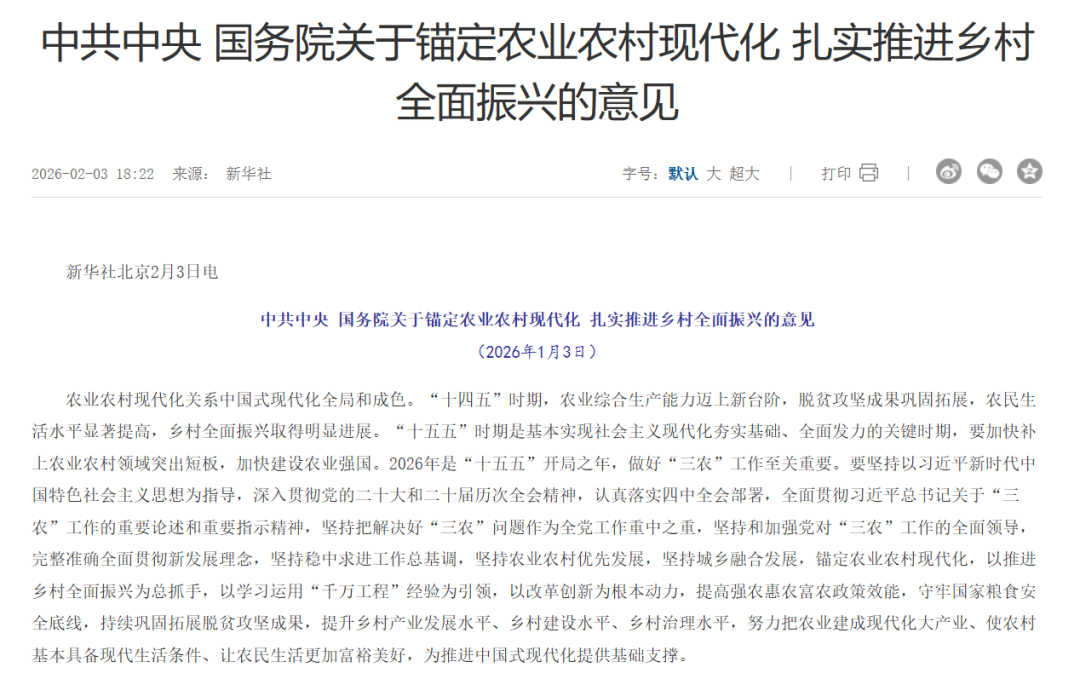
In early February 2026, the Central Committee of the Communist Party of China and the State Council issued the Opinions on Anchoring Agricultural and Rural Modernization to Solidly Advance Comprehensive Rural Revitalization. As the first Central Document No. 1 of the opening year of the 15th Five-Year Plan, this document not only sets the tone for annual work related to agriculture, rural areas, and farmers but also places higher-level and deeper requirements on rural waste sorting and resource utilization within the broader framework of building "livable, business-friendly, and beautiful villages."
Strategic Positioning: The Qualitative Shift from'Environmental Remediation'to'Systematic Governance'
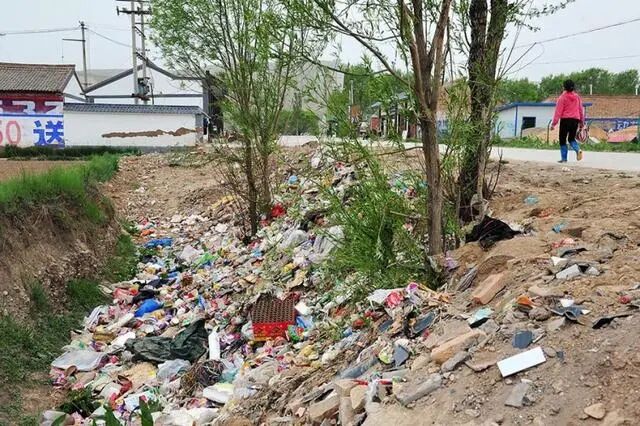
In past rural environmental governance, waste treatment was often regarded as an end-of-pipe "cleanup" operation. The 2026 Central Document No. 1 explicitly calls for learning from and applying the experience of the "Thousand Villages Demonstration and Ten Thousand Villages Renovation Project," shifting human settlement improvement toward systematic, regularized, and precise governance. Waste sorting, as the starting point of this chain, has risen to a core position in modernization of governance. By establishing a closed-loop model of "household sorting, village collection, town transport, and county processing," waste sorting has become a key entry point for addressing the challenge of "villages besieged by waste" and improving village aesthetics, reflecting the strategic shift in the state’s approach to rural living environments from "external beauty" to "internal quality."
Economic Empowerment: Resource Utilization Driving New Quality Productive Forces in Agriculture
The document particularly emphasizes the importance of developing new quality productive forces in agriculture, and the strategic significance of waste sorting lies in its role as a precondition for realizing resource recycling. In rural areas, a high proportion of domestic waste can be transformed into high-value recycled materials through precise sorting, achieving a remarkable turnaround from "waste" to resource. This pathway of resource utilization not only effectively reduces the costs associated with indiscriminate waste disposal but also fosters emerging industries such as material recovery and resource regeneration by building a circular economy industrial chain. This is a vivid practice of new quality productive forces in agriculture—turning environmental burdens into green momentum through technological and model innovation, thereby creating new space for increasing farmers’ income and industrial upgrading.
Ecological Foundation: Building a Green Barrier for Rural Revitalization
Ecological livability is the baseline of rural revitalization. The 2026 Central Document No. 1 reiterates the necessity of safeguarding ecological redlines. Waste sorting plays an irreplaceable role in protecting the rural ecological environment. Unsorted waste entering landfills or incineration often leads to soil pollution or secondary emission pressures. Through source reduction and refined sorting, the harm of non-degradable waste to the natural environment can be minimized, preserving the clear waters and green mountains of the countryside. This is not only a duty to fulfill ecological and environmental protection but also a commitment to leaving a clean land for future generations.
In summary, waste sorting is not merely a technical aspect of solid waste treatment but a crucial pillar in the construction of rural ecological civilization and the resource recycling system. Within the strategic framework of rural revitalization and agricultural and rural modernization established by the Central Document No. 1, accelerating the development of waste sorting systems will help solidify the foundation for green development in rural areas, enhance resource utilization efficiency, strengthen grassroots governance capabilities, and provide solid support for achieving sustainable development goals.
 Prev
Prev