





 Time:2026-06-17
 Source:
AI vs. Manual Sorting: Why Intelligent Automation Wins
For decades, manual sorting has been the backbone of recycling facilities – but it comes with high costs, inconsistency, and safety risks. Today, AI waste sorting is changing the game. With advanced sensors and machine learning, intelligent systems can identify and separate materials faster and more accurately than any human worker, while running 24/7 without fatigue.
How Qinglv’s AI Optical Sorter Delivers Superior Accuracy
The AI Optical Sorter from Qinglv is designed for high-volume, complex sorting tasks. It combines leading-edge AI vision technology with optional hyperspectral, laser, and metal detection sensors, enabling precise identification of over 30 types of recyclables – even in challenging environments. Operating at belt speeds up to 5 m/s and handling up to 10 tons per hour, it consistently outperforms manual picking in both speed and purity. Advanced lighting ensures stable performance regardless of external conditions, while cloud-based updates and predictive maintenance keep the system running at peak efficiency.
The Power of the AI Sorting Robot in Action
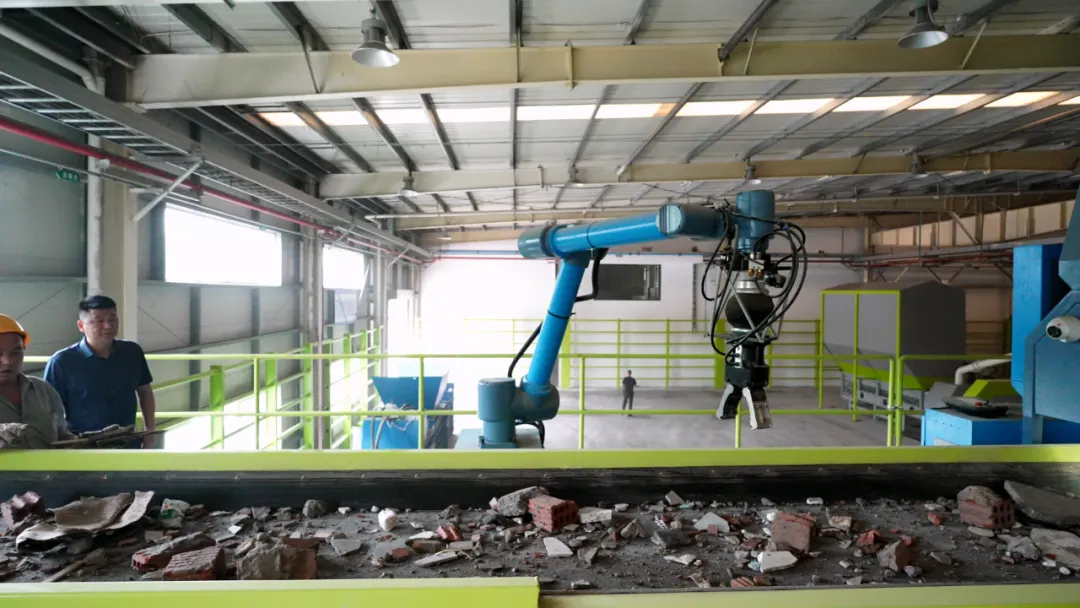
Qinglv’s AI Sorting Robot is a three-axis robotic arm built for front-line sorting and final quality control. It executes up to 5,400 picks per hour while sorting eight material categories simultaneously – equivalent to the output of 5-6 manual sorters. With recognition accuracy exceeding 95% for mixed waste and 99% for whole plastic bottles, it reduces contamination and maximises the value of recovered materials. The robot’s interchangeable suction or gripper end-effectors adapt to changing feedstocks, and its cloud-connected platform enables remote monitoring, instant fault response, and predictive maintenance.
Key Advantages of AI Sorting Over Manual Labor
AI-powered sorting offers clear benefits that directly impact your bottom line:
Higher throughput – 24/7 operation eliminates shift-related downtime.
Consistent purity – AI avoids human error and fatigue, delivering stable output quality.
Lower labour costs – One robot replaces multiple sorters, reducing payroll and training expenses.
Data-driven insights – Real-time performance data helps optimise the entire sorting line.
Adaptability – AI systems can be retrained or reconfigured for new waste streams without physical hardware changes.
Conclusion: The Future of Waste Sorting Is Intelligent
As waste streams become more complex and regulations more demanding, manual sorting can no longer keep up. Qinglv’s AI Optical Sorter and AI Sorting Robot provide a scalable, reliable, and profitable alternative – turning mixed waste into high-value resources with unmatched efficiency.
Ready to upgrade your sorting line? Contact Qinglv Environment today for a tailored AI solution.
 Prev
Prev